A most majestic bumper update for you, and a lengthy one at that so go get yourself a cuppa and a biscuit, or perhaps a whisky and shortbread and read my inane ramblings. There's quite a bit, I truly got lost in this and really wanted to do it justice, I hope this is interesting, useful and perhaps inspiring.
Over the last few months I have been working on the command for my Flodden Scots Army of 1513, which is of course, James IV.
Only a small command of 7 figures but something that I had to give my best shot at and do him justice. Reading as much as I could and spending many a night trying to piece things together. Here goes.
We must begin with James IV. His biography is truly something, he really was a Renaissance King in every sense. Wikipedia of course gives a summary which I urge you to read.
I have a few books that cover him but I must say that whilst the biographies available are voluminous, they are depressingly dry for such an engaging and interesting subject who had an incredibly rich life of forty years.
The figure was converted from a Steelfist Miniatures footknight (
pack Ren 28) with added plumes also from Steelfist, conversion on the right hand to take the pike, a gold collar, raised 'haute pieces' and of course the addition of the coat.
On the choice of figure I opted for one in a marching pose and was keen to have a French rather than Maximilian influence in the armour.
The plumes are somewhat ostentatious in hindsight but he’s the King ! As a guide for the coat I used an image from the Triumph of Maximilian depicting Knights on foot for the Tourney – which also features some impressive plumes. Note the slashing on the sleeves and chest. The coat looked huge when I sculpted it and was nearly discarded for a re-run but I pursued and once the whole figure was undercoated in black it was fine.
Inspiration for the collar came from a lesser known 1507 portrait of James IV which features a rather understated regal collar. This is not to be confused with the iron chain he wore in pennance for his involvement in the death of his Father at Sauchieburn. For the figure I used a cheap bracelet (I have a daughter)
Here's some images prior to painting, I tried my best to gently file off the moustache on the figure as James was clean shaven after his marriage to Margaret having formerly had a huge beard and long hair.
The more I read on him the more I love this man !
It didn't quite work in the end but it's a tiny detail. I also added a bit more detailing on the scabbard. The plumes are two different plume types from Steelfist miniatures, somewhat mimicking a blend of the styles shown in the woodcut above.
In painting James I was keen to ensure he was depicted in a heraldic surcoat as reference to this features in a number of sources.
The Lord High Treasurer’s accounts tell us that the coat was made of satin and cloth of gold (bought in London) with embroidered detailing. Also that his arming doublet was of black satin.
Another source mentioning James' coat is that of a sobering letter from Katherine of Aragon to King Henry VIII on 16 September 1513. This letter detailed the English victory against the Scots at Flodden Field. Henry VIII was on campaign in France, with Katharine Queen Regent in his absence. Along with the letter, she sent a piece of King James IV of Scotland’s coat.
‘My husband, for hastiness, with Rougecross* I could not send your Grace the piece of the King of Scots coat which John Glynn now brings. In this your Grace shall see how I keep my promise, sending you for your banners a king’s coat. I thought to send himself unto you, but our Englishmens’ hearts would not suffer it. It should have been better for him to have been in peace than have this reward. All that God sends is for the best.’
* Rouge Croix Pursuivant, English Herald, so called due to the red cross of St George on the surcoat. In this case referring to Thomas Hawley. He began his career in the royal service as messenger of the chamber for Queen Margaret of Scotland (James’ wife, Henry’s sister) and gained the position of Rouge Croix on 26 August 1509. In this position he was with the Earl of Surrey during the Flodden campaign. When arriving at the Scots camp he was imprisoned by James IV so that he could not reveal the Scots position nor give any detail of their numbers, communication with the English was then carried out by a Scots herald, Islay, who was in turn taken prisoner by the English for the same reason.
After the battle the King’s body was identified by Sir John Forman (see detail re the standard bearer below) and the Rouge Croix brought the news of James's death, along with the skirts of the king's coat, to Henry and the English Court on campaign in France.
It is interesting to compare sources, Katherine's letter suggests the whole coat was sent however further detail states that it was just the skirt - likely as the chest and sleeves were damaged.
Accompanying James are his beloved musicians.

James’ court included French, Italian, and German musicians including a number of trumpeters who were also used for signals on the march and in the field as is stated in this extract from the Scottish chronicler, Robert Lindsay of Pitscottie.
‘The king gart blaw the trumpitis and sett his men in order of battell. Then the trumpitis blew on evrie sycle and the wangairdis ioyn itt together. Then the Earl Huntlie and Lord Home blew their trumpitis and convenitt their menn agane to their standartis….The Earl Huntlie…. Callit his men together be sloghorne* and sound of trumpit to haue passit to the king.’
*battle cry
In addition to the European musicians at court there were also a number of Africans (believed to have entered Scotland as human booty captured by Scots privateers from Portuguese ships) most notably ‘the ‘
More taubronar’ d.1507 who was a drummer and travelling companion to James.
The tabret or tabor drum was used for dances at court and also in the field as in this example from the Schilling Chronicle 1478-83.
The More Taubronar features in the Treasurer’s accounts a number of times, for my interest there are some interesting references with regard to clothing issued to him and the other musicians at court.
Payments were made for scarlet bonnets for the trumpeters along with heraldic banners for their trumpets.
For the More Taubronar a coat was made of camlet fabric woven with black and red threads, with a damask doublet in grey and tanny (tawny), and begarried (striped) hose in December 1503. In December 1505 he was given clothes made from Bruges satin and tanny fabrics, the same costume as the four Italians. In May 1506 the "More taubronar" was given a yellow coat lined with taffeta ( likely the royal livery) for a special occasion when the king sailed to the Isle of May, a place of pilgrimage in the Firth of Forth.
As I mention above the More Taubronar died in 1507, James was greatly saddened by his passing and provided for his wife and child. I was keen however to represent the Moorish musicians at his court as their presence both predates and is of equal significance to those at Henry VIII's court such as the more well known John Blanke, 'the black trumpeter'.
I made a choice of artistic license to have a larger Swiss war drum, primarily as it lent itself to more easy decoration and particularly as James' army was emulating the Swiss and Landsknechts in the Flodden campaign.
The drum features James' coat of arms, based upon a modern reproduction of the cloth of estate which hangs in Stirling Castle (which is very much worth a visit !).
Some of the detailing was lost at this scale and slightly obscured by the fastenings but i'm happy with it, the painting magnification visor really came into its own here.
Using the prompts from the Treasurer's accounts I had these men in yellow jackets and red bonnets though note my comment on liveries below.

Here are the figures prior to painting, the bodies are the
Tudor dollies from Steelfist miniatures, the trumpeter arms are from the Perry Miniatures War of the Roses infantry set and the drummer arms are from Wargames Atlantic conquistador set. The drummer's head is from the Perry Ansar set and the trumpeters is also from Perry.

At either side of James are his standard bearers.
The flags are from the awesome Flodden range available from
Flags of War to which I painted on some further highlights and shading.
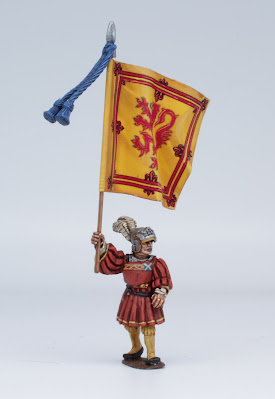
First up, Sir Adam Forman, 1470-1513 standard bearer to King James at the battle of Flodden.
James IV had four banners that were made specifically for the Flodden campaign, two in blue taffeta with painted details for the banner of St Andrew and St Margaret which I have
previously explored, and two directly associated to him. One embroidered with the Royal arms and another of ‘four ells of red silk’ which may have featured a saint, another banner of St Andrew or could have been a new Unicorn standard as per those shown in this image from a 1507 book of hours.
As these pre-date the banner mentioned they may / may not have also accompanied his host. I've put a pin in this to return to later as I want to represent these.....i'll just have to add more figures.
At Flodden Forman fell just minutes before James in the final moments of the battle. He had three brothers,
- Sir John Forman, serjeant porter to the King, captured after Flodden, helped to confirm the identity of the King’s body after it was taken to Berwick.
- Robert Forman, Dean of Glasgow cathedral
- Andrew Forman, Diplomat, Archbishop of St Andrews, Bishop of Moray, Archbishop of Bourges (France) In France at the time of Flodden
The next standard is this one also from Flags of War which features his motto 'in defens'. I included this as it helped to frame the command stand.

Sadly Forman is the only named standard bearer associated to James that I could find, we know there were more but they are lost to history.
Of note there is 'Black' John Skirving of Plewlandhill East Lothian, who carried the '
veritas vincit' (truth prevails) standard of the Earl Marischal who was alongside James. The standard which, thanks to his cunning in concealing it after his capture and imprisonment, still survives in the collection of the
faculty of advocates.
Whilst this 'in defens' standard of James IV did not survive the motto does. It is associated with the Scots Royal Arms and was used by James IV. The origins lie in an old Scots prayer, of which there are several versions including:
'In my defence God me defend
And bring my sawl to ane good end
ane vertuous lyf procureth ane happie death...'
And:
'In my defence God me defend
And bring my soul to ane good end
When I am sick and like to die
Father of Heaven have mercy on me.'
Also, in the form of a couplet:
'In my defense God me defend
and bring my saulle to ane guid end O Lord'
Whichever, it is all the more appropriate to represent given James' end.
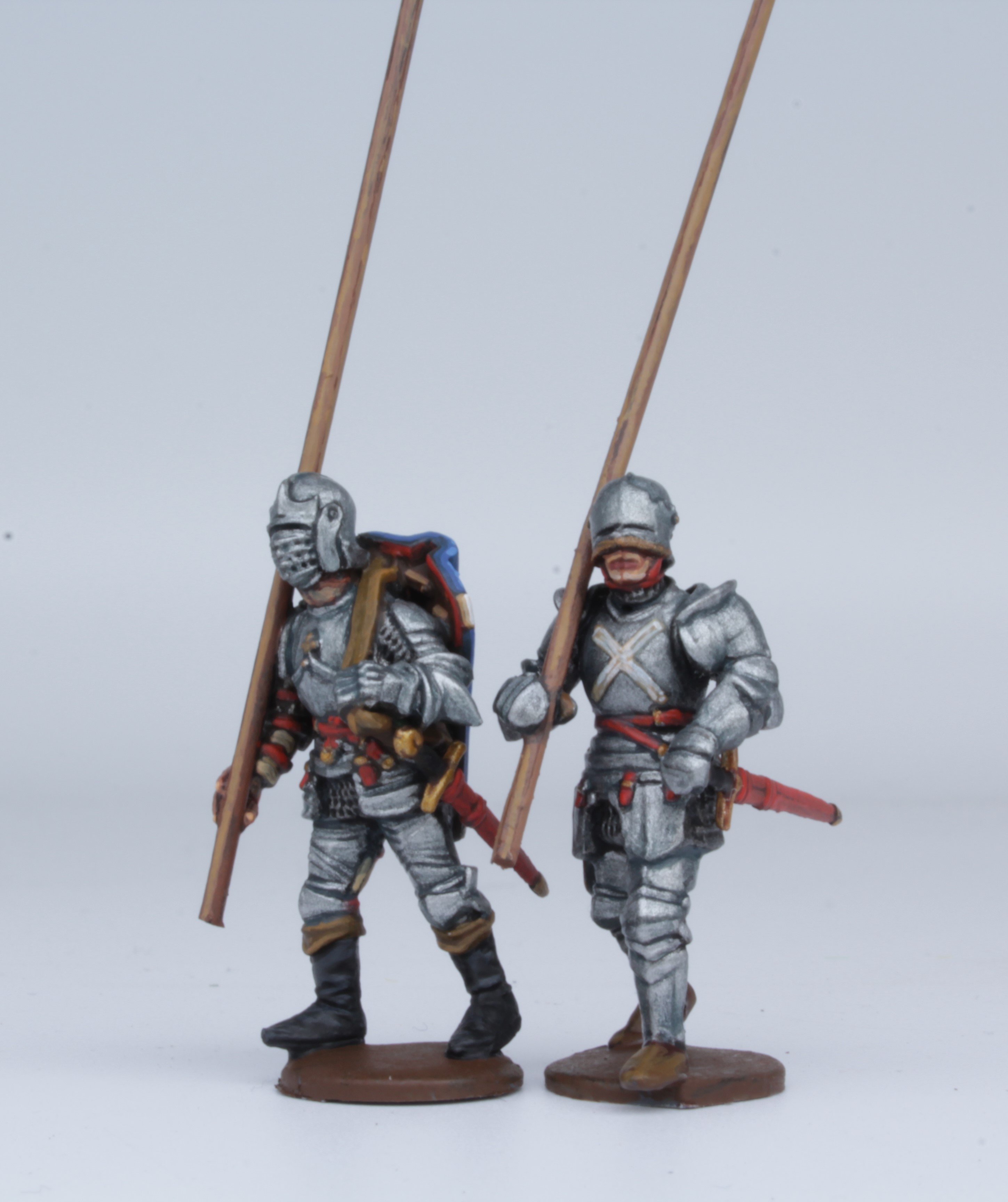
The last elements of the command are two splendidly armoured gentlemen, these are a nod to James' bodyguard, 'The Archers Guard'.
Both were kitbashed using the Perry Miniatures Mercenaries and Foot Knights sets. In the case of the figure in full plate I cut individual shoulder, elbow and gauntlets to achieve the right pose, it was pretty easy and fun to do, I created a batch of them, hopefully this image helps to show the process a bit more.
Note the pavise on one of the figures, this was a tactic used at Flodden to counter the English longbows,
'the scots were so surely harnessed with complete harness, german jacks, rivets, splents, pavises and other habilements that shot of arrows in regard did them no harm.'
Some of those in the front rank carried 4ft pavises as additional defense against archery. These were supported by a diagonal 'guige' strap for ease of carrying and presenting. It is likely they were discarded when coming to blows.
James IV’s personal bodyguard ‘The Archers’ Guard’ were originally archers from the Forest of Ettrick, also known as ‘The Flowers of the Forest’ after the Battle of Falkirk 1298.
They were part of a noble elite, sworn to be at the Sovereigns side in times of danger. After the battle, the King’s body was supposedly found surrounded by the bodies of his archers. The Guard had stood firm around their master and like him, had fought to the end. The tradition of the Archers’ Guard was revived in the 17c with the formation of the Royal Company of Archers which still functions to this day as a ceremonial bodyguard in Scotland.
These may have been among those in the front ranks of James’ 15,000 strong division described by the English as
‘...... the most assuredly armoured that hath been seen and the tallest and goodliest persons withal.’
Unfortunately, I have not been able to find any detail on them. In fact, I have only found reference to their name in secondary sources and as to whether any livery or weapons were issued, nothing is stated in the Treasurer’s accounts. It may be that these were more a noble elite in an order of some kind as opposed to a formal uniformed bodyguard. For comparison, something akin to Henry VIII's King's Spears rather than his Yeomen of the Guard.
While searching for these I found that livery items are mentioned in the Treasurer’s accounts but only for the King, musicians as above and possibly as passing references to Lion badges.
Other than that, I can’t find anything further for Royal livery. Of interest there are a lot of references for payments of livery items -curiously by the crown, for liveries of various nobles in various lists as, for example.
'Item for ane pair of hos of carsay – livery of Arche Douglas'
Plain white saltire field signs were many in James’ army, largely as it was without uniform. Henry’s army was perhaps paramount in the period in organisation and proportion of men in uniform and was commented upon as thus.
Here's the whole command prior to basing.
Quite a special moment once they were based and something i've been anticipating since the start of this army years ago. As the other banners were previously completed I can now represent James' division at Flodden, leading the Flowers 'o the forest of his guard, the court and key members of parliament.
but not quite.......
There's perhaps one more base to add to James' division and i've mentioned it already, William Keith the Earl Marischal with the 'veritas vincit' banner, whose role as protector of the King's person would see him in the thick of the action.
'William' brings me full circle.
Doing a key command such as this for a collection based upon the Flodden campaign was something I put off for a number of years, largely as it's intimidating in a way, but perhaps moreover that i'm a champion procrastinator and at times a self critical perfectionist to the point of inertia.
There was also for a while an absence of suitable figures and knowing very little about James IV and those around him on that fateful day in September 1513 was an obvious barrier too.
Quite a bit is out there as I've summarised above and I suspect my effort here only scratches the surface.
One only needs to jump down the rabbit hole of reading and the internet but sometimes inspiration appears in unexpected forms.
I dedicate this in memoriam to a great Scotsman, James IV would have loved him, my dear 'Uncle Wullie'
Slainte
Bye for now and Happy Father's Day.
Stuart




.jpg)




_-_Alte_Pinakothek,_Munich.jpg)


